
More than something to watch.
An immersive experience, simple physical interaction and a clinical context that stays central.
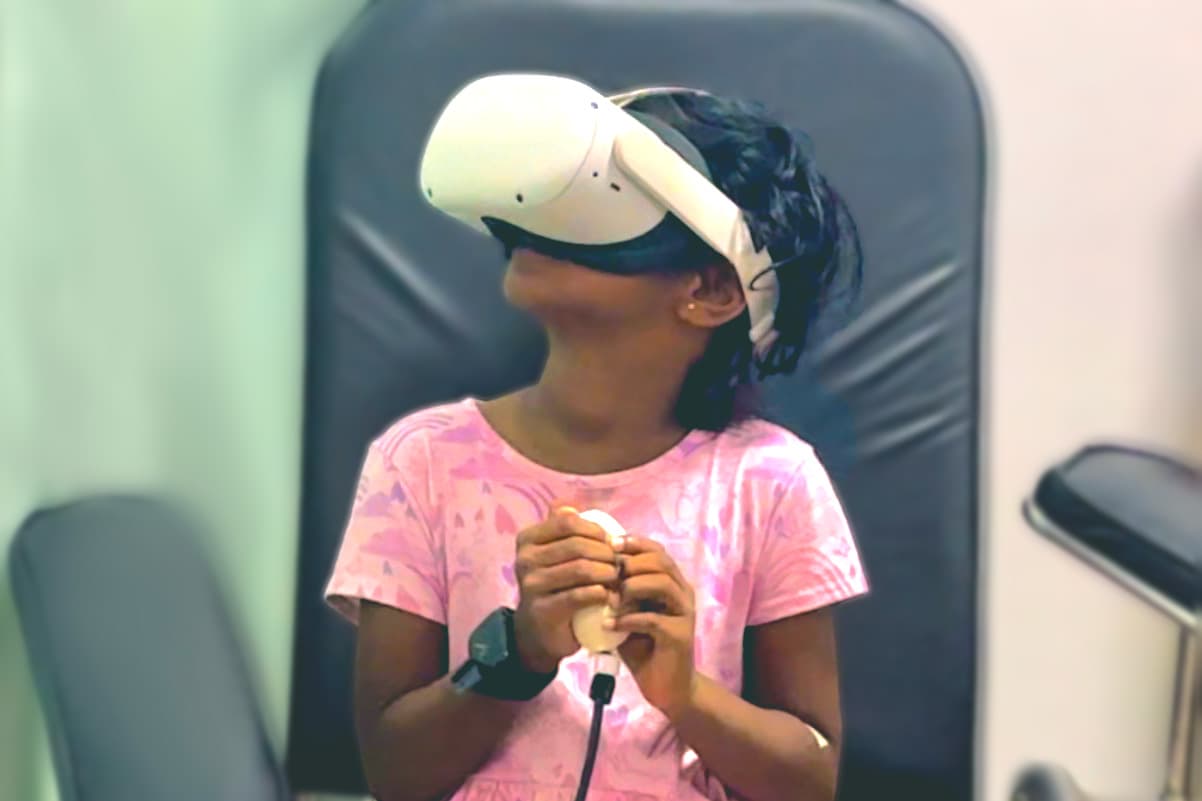
Another place for attention to go.
The child explores a virtual environment and interacts through a simple input while the healthcare team continues normal care.
The research behind Immersive Smile investigated a combined adaptive VR and tactile-feedback approach. A proposed hospital pilot should specify the actual headset, software and input configuration and how they relate to the research prototype.
Designed around the moment of care.
Introduce the experience
Explain the headset and interaction, and confirm the child is willing and comfortable.
Give the child something to do
Simple physical input creates a connection with the virtual experience.
Keep the clinical task central
Healthcare professionals continue appropriate care and maintain access to the procedure site.
Immersion. Interaction. Appropriate responsiveness.
Virtual environment
Age-appropriate content offers a different visual and auditory focus. Request a current demonstration rather than assuming archive imagery shows the latest content.
Tactile input
The research used a sensor-enabled squeeze device. Comfortable handling, clinical access and the current hardware configuration need to be confirmed for the proposed setting.
Adaptive research
A DQN-based research system used contextual signals to inform changes to the environment. It did not make independent clinical treatment decisions.
Care remains primary
Suitability is determined with the healthcare team. The child can decline or stop. An immersive experience does not replace medication, anaesthesia, assessment or clinical judgment.
Press the control to illustrate the interaction.
Interaction illustration—not a live device or patient measurement.
Understand the evidence behind the approach.
The published randomized comparison relates to venipuncture. New product configurations and clinical settings should be evaluated on their own terms.
Clinical evidence →Mean pain score / 10
Mean pain score / 10
Two groups, not a before-and-after result. Randomized venipuncture study; 50 participants, 25 per group. Reported p < 0.001. Individual responses vary.
Read the publication ↗What would a better procedural experience look like at your hospital?
Tell us your department, country and clinical interest. We will discuss the right starting point for a demonstration, pilot or research collaboration.
International enquiries are welcome. Availability and implementation depend on local requirements.